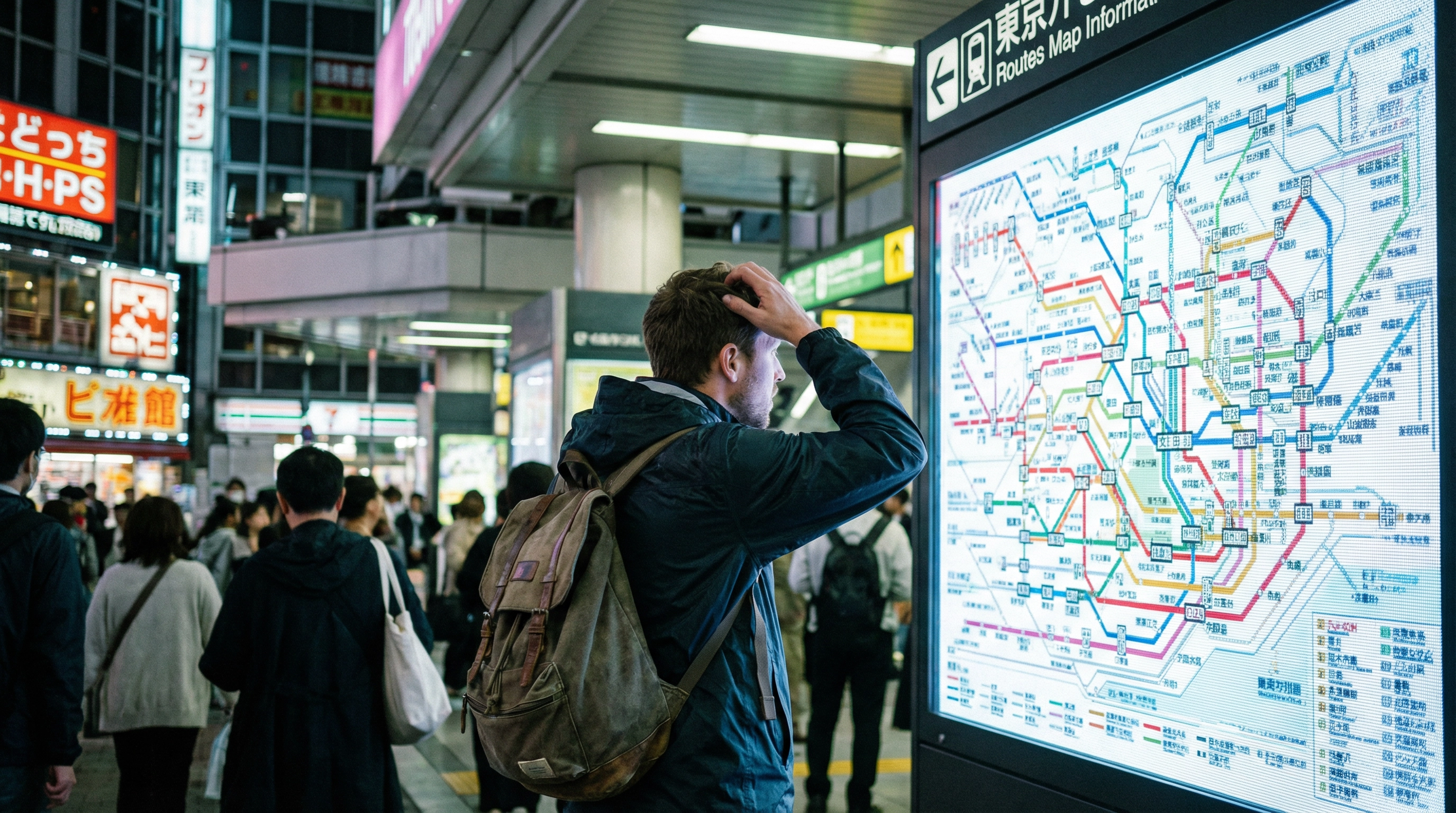
The Anxiety of Arrival: Why We Freeze at Foreign Stations
There is a specific kind of silence that falls over a traveler standing in front of a ticket machine in a foreign country. It’s not a quiet environment—usually, it’s a bustling station in Tokyo, Berlin, or Paris—but the silence is internal. It is the sudden, heavy realization that you do not know how the world works here.
We spend months planning our itineraries. We book flights, reserve hotels, and pin restaurants on digital maps. But we rarely rehearse the transitional moments. We assume that getting from Point A to Point B is just a logistical detail, a line connecting two dots. In reality, that line is where the friction lives.
The Cognitive Load of the Unknown
The problem isn't usually language. In an era of instant translation apps, we can read the words "Select Fare" or "Insert Cash." The problem is the system.
I remember my first time in the Tokyo Metro. I wasn't confused by the destination; I knew exactly where I wanted to go. I was paralyzed by the process. Did I buy a ticket for the line, or for the distance? Did I need to tap in and tap out, or just tap in? If I made a mistake, would a gate close on me, triggering a siren and a polite but firm reprimand from a station attendant?
This is the anxiety of arrival. It is the fear of looking incompetent in public. When we travel, we strip away our local authority. At home, we swipe through turnstiles without breaking stride. We know which bus door to open. We know that the 5:15 train is always late, but the 5:20 is reliable. Abroad, we are infants again, relearning the physics of movement.
The Cost of Hesitation
This hesitation has a cost. It’s not just the five minutes you spend staring at the map; it’s the energy drain. Decision fatigue sets in before you’ve even left the airport.
I’ve watched couples argue fiercely over which exit to take, not because the exit matters, but because their cortisol levels spiked the moment they couldn't find the ride-share pickup zone. I’ve seen solo travelers drag suitcases over cobblestones for twenty minutes because they were too intimidated to figure out the local tram system.
We often default to the path of least resistance, which is usually the most expensive one. We jump in a taxi not because we want to spend $80, but because the taxi requires zero cognitive load. You get in, you say a name, you pay. It is a safety tax we pay to avoid the complexity of the local infrastructure.
Breaking the Paralysis
The only way to dismantle this anxiety is to reframe the goal. The goal of your first hour in a new city is not efficiency; it is orientation.
Give yourself permission to stand still. When you step off the train, don't rush to the exit. Find a wall, lean against it, and watch. Watch how the locals move. Do they validate their tickets before boarding? Do they queue on the left or the right? Do they hail taxis, or do they wait at stands?
Observation is your primary tool. In The Rhythm of Transit, we explore how different modes of transport change the way you perceive a city, but before you can choose a mode, you must understand the rhythm.
Accept that you will make a mistake. You will buy the wrong zone ticket. You will miss your stop. You will accidentally stand in the "Women Only" car during rush hour and feel the collective gaze of a hundred commuters. It happens. It is not a failure of planning; it is the tuition fee of travel.
The Shift to Competence
There is a magical moment, usually around day three, when the anxiety lifts. You walk into the station, your hand instinctively finds your travel card, you tap the reader without breaking your stride, and you navigate the transfer without looking at the signs.
You have not just learned a route; you have decoded a system. That feeling of competence is one of the most underrated highs of travel. It is the moment you stop being a package being delivered to a destination and start being a participant in the city's life.
So, the next time you find yourself freezing in front of a ticket kiosk, take a breath. The machine is not judging you. The crowd is not watching you. You are just learning a new language, one button press at a time.
For more on the hidden challenges of travel, read about The Fine Print of Reality.